

I've reported on mental health for years. I'd never heard a doctor dismiss breathing exercises this bluntly.
Dr. Adrian Corvell told me: "The anxious brain cannot be willed into calm. It's biology. Asking someone to relax their way out of anxiety is like asking them to slow their heart rate down by thinking about it."
Dr. Adrian Corvell has spent over a decade in a Columbia-affiliated lab studying how the anxious brain processes sound. By the end of our conversation, I understood why millions of people are stuck, and what actually works.
"The problem isn't effort. The problem is biology," he told me. "The brain has to be guided, through the right neurological input, at the right frequency, in the right sequence."
31% of U.S. adults will develop an anxiety disorder at some point in their lives. They'll spend an average of $1,000+ a year managing it. And according to Corvell, most of what we're told to do about it is neurologically useless.[5]
And the cost compounds. Broken sleep means lost productivity, blunted focus, and a body that never fully recovers — a price tag that goes well beyond what shows up on a receipt.
Most people don't quit because the techniques fail. They quit because they conclude they're the problem.
"Count to ten." "Breathe slowly." "Think positive thoughts." It asks the stressed brain to regulate itself.
But a brain flooded with cortisol and running on threat-detection mode literally cannot do that job.
What it can do is respond to sound.
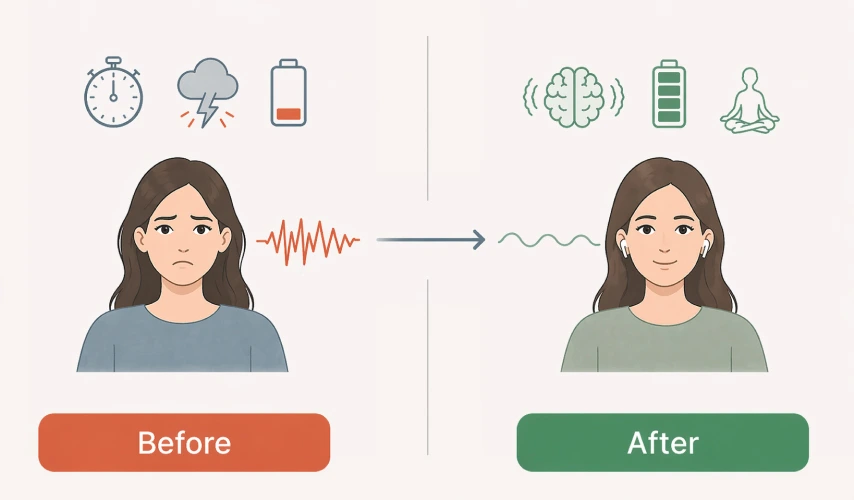
Why "just relax" is neurologically impossible, and what actually works
When you're anxious, your brain produces high-amplitude beta waves — fast, jagged electrical patterns associated with threat-scanning and active problem-solving.
Telling a brain in beta-wave overdrive to relax is like asking a car engine revving at 6,000 RPM to idle by taking your hands off the wheel.
It doesn't work that way.
What neuroscientists discovered, first at Columbia and then validated by teams at Yale and MIT, is that the brain synchronizes its electrical activity to external rhythmic stimuli.
They call it neural entrainment.
"Play a 10 Hz alpha-wave tone (the frequency associated with calm alertness), and a stressed brain will begin migrating its own electrical patterns toward that state," Corvell explains.
"You're not forcing it to relax. You're giving it a signal to follow."
This is the science behind binaural beats: two slightly different tones played into each ear create a perceived "third tone" — a beat — that corresponds precisely to a target brainwave frequency. The brain locks on. The nervous system follows.[1]
The research is now extensive. A 2022 peer-reviewed study found binaural beats at alpha frequencies (8–13 Hz) reduced state anxiety scores by nearly 30%.[2]
A large-scale meta-analysis of over 20 studies confirmed targeted sound protocols reduce anxiety and improve emotional regulation.[3]
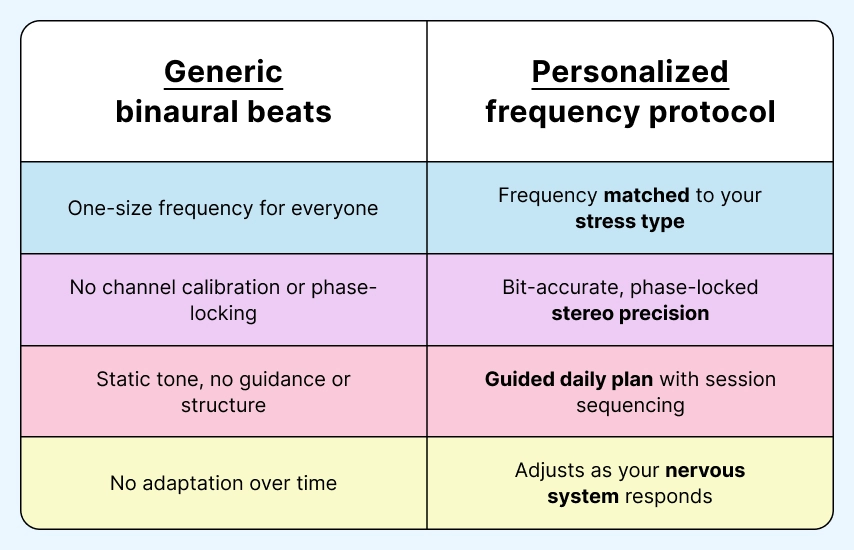
So if binaural beats work, why are so many people still anxious?
"The science works," Corvell told me flatly. "But the application is almost always wrong."
"In a lab setting, we'd never play a single static frequency for twenty minutes. The brain habituates. You need ramped sequencing, transitions calibrated to the user's baseline state. Generic audio has none of that."
He pulled up a typical YouTube binaural beats video. Three million plays. Labeled "10 Hz alpha for deep relaxation." Useless, he said, for anyone with real anxiety.
"Three things determine whether a binaural beat session actually entrains your brain:
- frequency precision,
- channel calibration,
- and sequencing.
Generic audio gets none of these right. The frequency may be labeled 10 Hz but drift. The channels aren't phase-locked. There's no protocol — just a static tone with no guidance."
Different types of anxiety also need different target frequencies.
What works for a 2 a.m. mind-race isn't the same as what works for pre-meeting panic.
If you're the person who lies awake at 2 a.m. running through tomorrow's meeting, or the one whose mind starts spinning the moment you close your laptop, you're not failing at relaxation. Your brain is in beta-wave overdrive and it needs a signal to follow, not more effort.
"Anxious people try YouTube binaural beats, feel nothing, and conclude the science is pseudoscience," Corvell said.
"The science is sound. The delivery is broken."
Corvell points to one platform that finally matches clinical precision
For years, Corvell refused to publicly endorse any binaural beats product on the market. None of them, he said, matched clinical conditions.
That changed when he came across InnerFlo. "What's different here is the starting point," he says.
"Before you hear a single tone, the platform maps your specific stress pattern — the type of anxiety you carry, when it tends to spike, how it affects your sleep.
Only then does it assign your frequency protocol — short daily sessions, between 8 and 25 minutes, calibrated to your specific stress signature and adjusted as your baseline shifts. That's exactly how we'd design it in a lab setting."
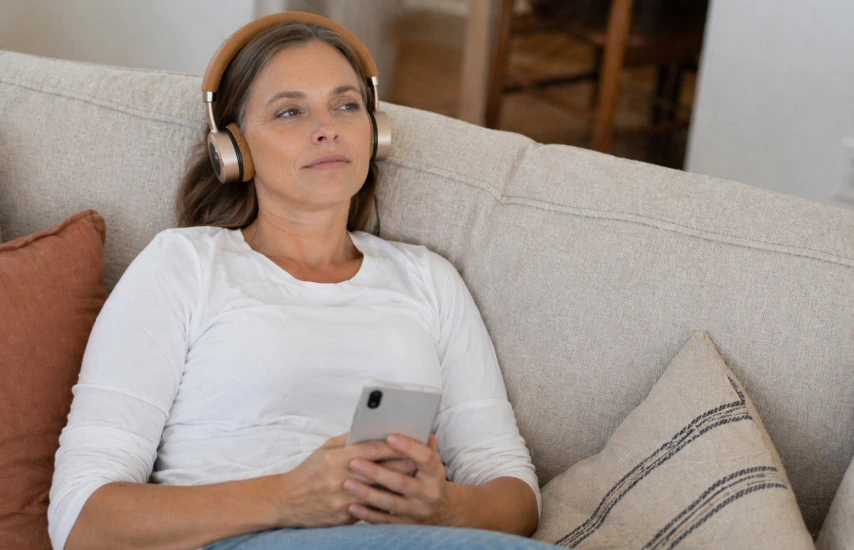
I tried it myself
After the interview, I couldn't get what Corvell said out of my head. So I did what any reporter does. I tried it.
Two-minute quiz. It asked about my sleep, when my stress tends to peak, what my mind does at 3 a.m. Then it built me a protocol.
First session: twelve minutes. I expected nothing. By minute 8, I noticed my jaw had unclenched — something I hadn't realized I'd been doing all day. By minute 12, I stopped tracking the time. The next morning, I woke up without the usual chest-tightness, and that was the moment I understood what Corvell meant. It was the quietest head I've had in months.
That's when I asked InnerFlo if Health Horizon readers could have access to the same personalization quiz.
They said yes, and threw in something else: 60% off, only available through the quiz.
It's a much more affordable route than therapy, prescriptions, or supplements.
The science is settled. The personalization is what most people are missing. And there's a 30-day money-back guarantee if it's not the right fit for you.
The ideal Stress Reset looks different for everyone.
Get a guided binaural beats routine tailored to your needs
Results may vary due to personal features